Refactors the KYC scoring logic to “simplify” a branch that looks redundant.
Persistent project context for developers and AI agents
Your AI coding agent knows your code. It doesn’t know your project.
Give developers and AI agents persistent access to requirements, architecture decisions, meetings, documentation, and project memory across tools and sessions.
- ✅ Self-hosted
- ✅ Project-scoped
- ✅ Source-backed
ContextHarborInteractive sample
PROJECT / ATLAS PAYMENTS
Ask with project context
Why does reconciliation run at 2am instead of on demand?
Answer grounded in 2 sample sources
Project context recovered
The banking provider finalizes settlement at 1:30am. The 2am window allows settlement to complete before reconciliation begins.
Before changing this: preserve the settlement window and confirm the provider’s timing constraints.
↳ ADR-014 · Reconciliation schedule
Sample excerpt: Run reconciliation at 02:00 after the provider’s settlement batch. On-demand reconciliation could read incomplete settlement data.
↳ Provider integration notes
Sample excerpt: Settlement finalizes at 01:30. Reserve a 30-minute buffer before consuming the completed batch.
Illustrative workflow with fictional project data. No live query is sent.
The context outside the repository
Source code tells an agent what exists. Project knowledge explains why.
Requirements change in documents. Constraints surface in meetings. Architecture rationale lives in ADRs and senior engineers’ memories. A coding agent cannot reliably infer that history from source code alone.
Finds the regulator finding that mandated that exact branch, and the compliance sign-off behind it, before touching the code.
Shared understanding
One project understanding across developers and AI tools.
Beyond source code
Bring requirements, product decisions, architecture rationale, meetings, and runbooks into the development workflow.
Across tools and sessions
Keep project context independent of one model, IDE, context window, or individual developer.
With evidence
Return inspectable sources and preserve project boundaries instead of relying on an agent’s unsupported recall.
What your project knows
Keep what the project says, how the team works, and what the team learned.
Documents
Specifications, architecture, requirements, APIs, runbooks, meeting transcripts, and other source material.
Reusable prompts
Implementation practices, review prompts, engineering conventions, and repeatable team workflows.
Explore promptsDecisions & memories
Decisions, constraints, lessons, rationale, and historical knowledge that documentation missed.
Explore memories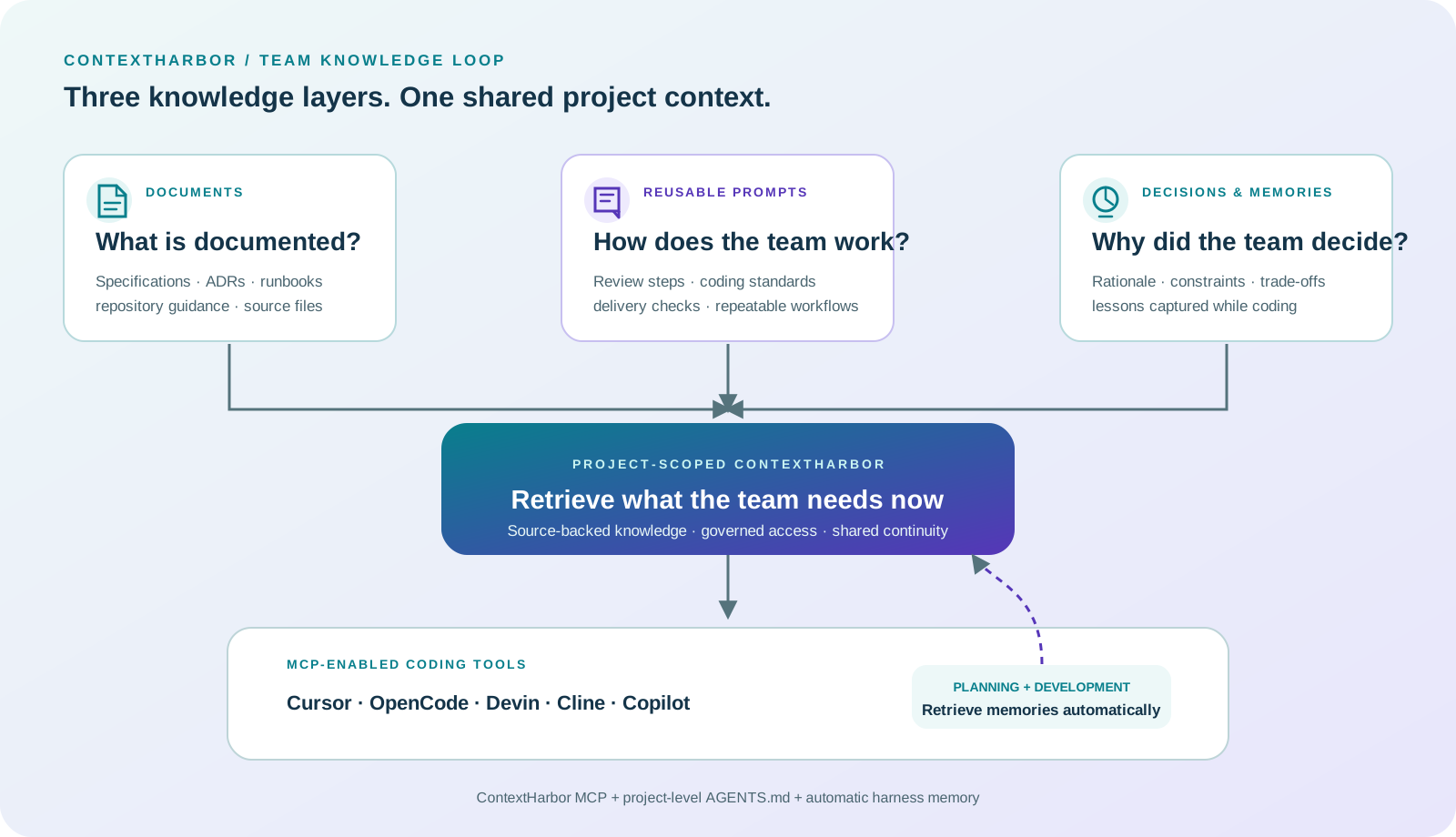
Developer path
First useful retrieval in about 15 minutes.
Start with one project and one question your team repeatedly has to reconstruct.
1. DeployRun the Docker deployment inside infrastructure you control.
2. Add project knowledgeUpload three to five architecture, requirements, or decision documents.
3. Connect a coding toolUse Claude Code, Codex, Cursor, Cline, OpenCode, or another approved MCP client.
4. Ask with contextRetrieve the constraints and decisions that matter before modifying the code.
Product evidence
Explore ContextHarbor in five views.
Styled product visuals based on portal captures, with a light presentation and illustrative project names. Explore projects, answers, sources, documents, and agent setup.
Keep each project’s knowledge organized in its own workspace.
Private by deployment
Your engineering knowledge stays inside infrastructure you control.
Project namespaces, scoped access, source-backed retrieval, and administrator-controlled providers close the trust gap after the workflow proves useful.
Evaluation access
Stop rebuilding project context in every coding session.
Tell us about your project and development workflow. We will contact you to arrange licensed evaluation access and setup guidance.