Why did we choose this architecture?
Recall the alternatives, constraints, and rationale behind the choice.
Decisions made while coding
Documentation rarely captures every implementation decision. ContextHarbor makes the rationale, constraints, and lessons that emerge during coding available throughout planning and development.
PROJECT / ATLAS
Why did we disable automatic retries for payment creation?
Sample memory recalled
Team decision recovered
A previous incident produced duplicate payment requests after an ambiguous timeout. The team decided to check the provider’s payment status before allowing another creation attempt.
Next step: Preserve the status check when changing timeout or retry handling.
Decision: do not blindly retry payment creation after a timeout. First resolve the provider status using the original request reference.
Rejected a generic retry wrapper because a timeout does not establish that the provider failed to create the payment.
Illustrative workflow with fictional project data. No live query is sent.
When someone is unavailable
John is on leave. Why did the team add the
risk_status column, and what depends on it?
ContextHarbor can recall the reason, constraints, affected components, and source context without asking the team to reconstruct the discussion.
Questions team memory answers
Why did we choose this architecture?
Recall the alternatives, constraints, and rationale behind the choice.
What did we decide during the last coding session?
Continue from agreed decisions without replaying the entire conversation.
What should the next developer know before changing this?
Surface non-obvious dependencies and warnings alongside source documents.
What the team learned
Decisions, constraints, lessons, and rationale that remain useful after the original conversation ends.
Previous approaches, important changes, and the context around how the team reached its current implementation.
Non-obvious warnings, dependencies, and team knowledge that developers and agents need during active work.
Available during active work
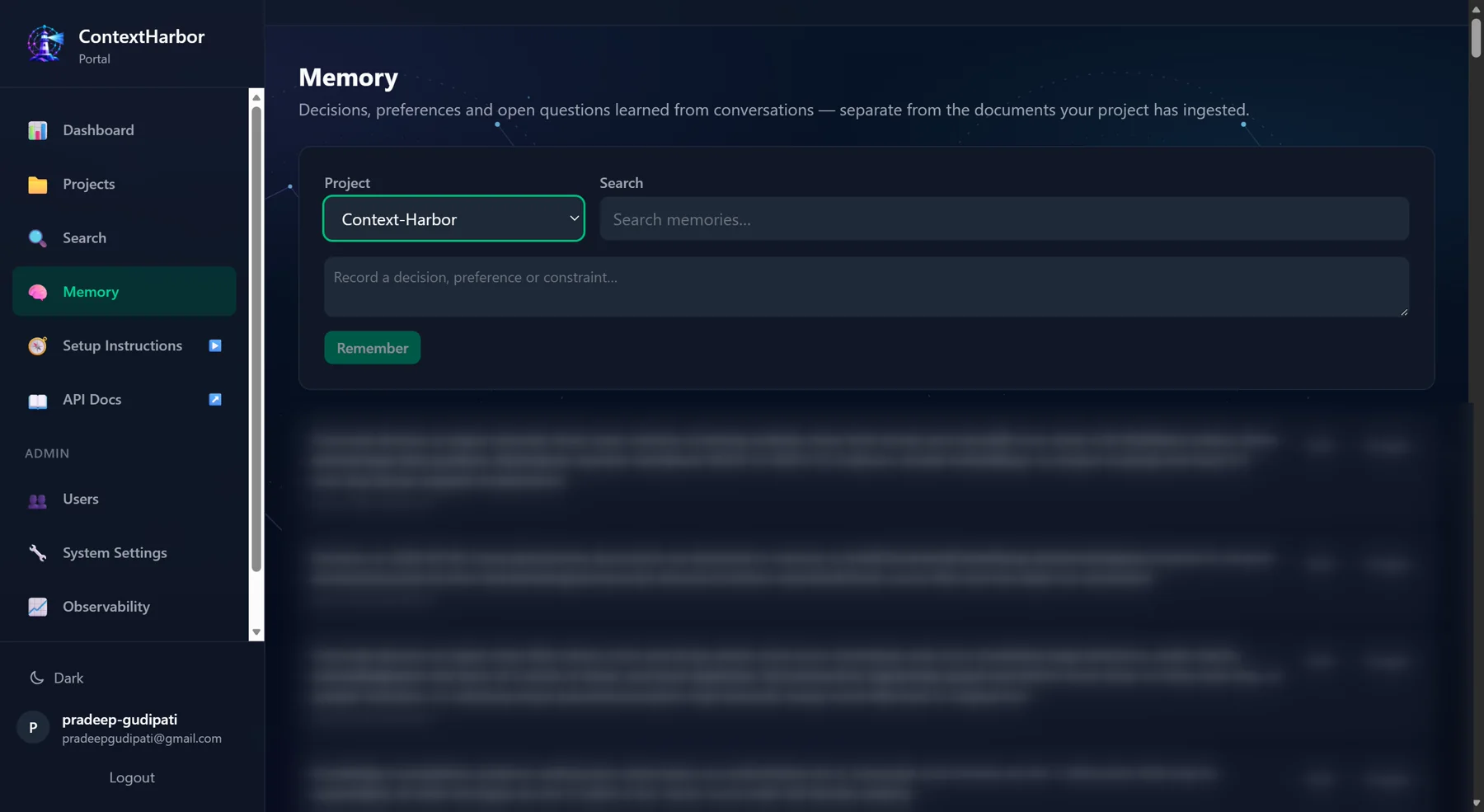
Memory Engine
The newer memory surface treats each coding session as a first-class record: what it set out to do, what it decided, and what the next session should pick up.
A session opens when work starts and closes with a summary of what changed, so a later session can continue from a known point rather than from scratch.
A session handoff is stored as an immutable, verified record — the explicit "here is where I left off" that survives context limits and staff changes.
Each memory keeps its source chain and a timeline, and surfaces conflicting entries, so a reviewer can check a decision instead of trusting it blindly.
Write-ahead capture means a decision is recorded before the extraction job runs, so nothing is lost if a session ends abruptly. It runs alongside the existing project memory.
Preserve the why
Start with the decisions your developers repeatedly have to rediscover.